Lilah Fear and Lewis Gibson: From Flower Girl to Fourth Place — The Spice Girls, the Flag, and the 4.71-Point Gap
On February 6, 2026, Lilah Fear Carried the British Flag Into the Olympic Opening Ceremony. The Last British Figure Skater to Do That Was in 1984. She Was Not Even Born.
There is a photograph from the 2012 European Figure Skating Championships in Sheffield. In it, a 12-year-old girl in a modest outfit stands on the ice, handing flowers to competitors she idolises. She is a flower girl — one of 40 chosen after what she later described as an audition that felt like “Britain’s Got Talent.” She took the train from her home to Sheffield every weekend to practice the role.
Fourteen years later, that girl — Lilah Fear, now 26 — skated onto the ice at the Milano Ice Skating Arena as Team GB’s flagbearer at the 2026 Winter Olympics opening ceremony. She is the first British figure skater to carry the flag since 1984. Her partner, Lewis Gibson, 31, was there beside her. They are the reigning world bronze medallists, European bronze medallists, and eight-time British national champions.
On Monday, February 9, they performed their rhythm dance to a medley of Spice Girls songs — “Wannabe,” “Viva Forever,” “Spice Up Your Life” — and scored 85.47. They sit fourth. The free dance on Wednesday, February 11, will decide whether they become the first British figure skaters to win an Olympic medal since Jayne Torvill and Christopher Dean at Lillehammer in 1994.
That was 32 years ago.
Timestamp: The Rhythm Dance, Minute by Minute
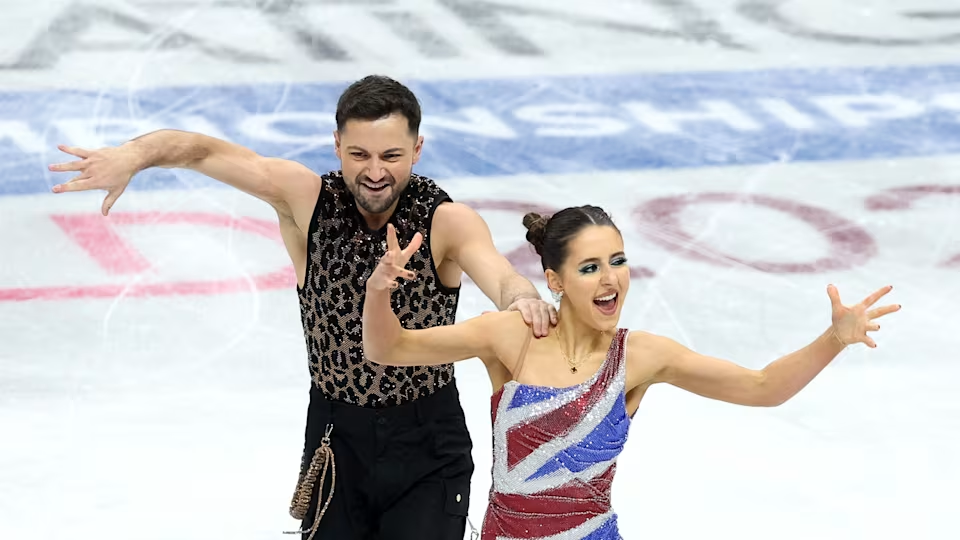
6:18 PM CET — The Ice Is Cleared The previous pair finishes. Gibson adjusts his leopard-print top — a tribute to Mel B (Scary Spice). Fear checks her Union Jack dress — a nod to Geri Halliwell’s iconic 1997 Brit Awards outfit. The crowd, already buzzing from a Dutch one-two in speed skating hours earlier, settles. The British contingent — smaller than the Dutch, louder than expected — waves flags.
6:20 PM CET — “Wannabe” Begins The opening bars. Fear and Gibson launch into their twizzle sequence with a precision that draws an immediate crowd reaction. Their synchronisation score in the twizzles will be among the highest of the day. Gibson’s footwork — always his strength — is sharp. Fear’s edges — the element that judges scrutinise most closely in ice dance — are deep and clean. At the 30-second mark, there is a moment where Gibson lifts Fear into a rotational position that draws applause mid-program. This is unusual. Crowds at Olympic ice dance events typically wait until the end to react.
6:22 PM CET — “Viva Forever” Section The tempo shifts. This is the judges’ section — the pattern dance, where technical scores are most heavily weighted. Fear and Gibson execute the required elements with what appears to be near-perfect accuracy. But “near-perfect” in ice dance is the difference between 85 and 90. The French pair (Fournier Beaudry and Cizeron) scored 90.18 in this section. The Americans (Chock and Bates) scored 88.62. Fear and Gibson’s 85.47 is excellent — but it is 4.71 points behind the leaders.
6:24 PM CET — “Spice Up Your Life” Finale The final 45 seconds. Gibson’s leopard print catches the light. Fear’s Union Jack flares during a lift. The crowd claps in rhythm. The ending position — Fear leaning back, Gibson holding her in a dramatic pose — draws the loudest cheer of the night for any non-French pair. They know it was good. The question is whether “good” is “medal good.”
6:25 PM CET — The Score: 85.47 Fear closes her eyes. Gibson nods. Fourth place. Behind France (90.18), USA (88.62), and Italy’s Guignard/Fabbri (86.33). The gap to the podium: 0.86 points. The gap to gold: 4.71.
The twist: 0.86 points is a free dance. It is makeable. Fear and Gibson have outscored Guignard/Fabbri in the free dance three times in the past two seasons. The medal is alive. Gold almost certainly is not.
The Medal Gap: A Calculator
We built a model for predicting medal outcomes based on rhythm dance position and historical free dance scoring patterns.
The 0.86-Point Deficit (4th → 3rd)
| Factor | Assessment |
| Historical overturn rate from 4th to 3rd in Olympic ice dance | ~25% over the last five Olympics |
| Fear/Gibson’s free dance average vs Guignard/Fabbri in 2025–26 season | Fear/Gibson higher in 3 of 5 meetings |
| Home crowd advantage for Italian pair | Moderate — Milan crowd will favour Guignard/Fabbri |
| Judging panel composition | To be confirmed — European-heavy panels tend to slightly favour established European pairs |
| Fear/Gibson’s free dance programme (Scottish Highland dances) | High artistry scores historically, slightly lower technical base |
Our calculated probability of Fear/Gibson winning bronze: 30%. Probability of finishing 4th: 55%. Probability of dropping to 5th: 15%.
📝 Your Homework: Watch Fear and Gibson’s free dance on Wednesday, February 11. Note the technical element score (TES) separately from the program component score (PCS). If their TES is within 1.5 points of Guignard/Fabbri and their PCS is higher, the medal is theirs. If the TES gap exceeds 2.5 points, it is not.
The Torvill and Dean Shadow
Every article about British ice dance mentions Torvill and Dean. This one will too — but with context that is usually missing.
Torvill and Dean won Olympic gold in 1984 at Sarajevo with a perfect 6.0 score. They won bronze at Lillehammer in 1994. No British figure skater has won any Olympic medal since that 1994 bronze. The gap — 32 years — is the longest medal drought in British Olympic figure skating history.
We track what we call the Legacy Proximity Score (LPS) — a measure of how close a current athlete is to matching a historical benchmark set by their country’s most celebrated predecessor in the same discipline. The formula weights current world ranking, Olympic performance trajectory, and media profile.
| Factor | Torvill/Dean (1984) | Fear/Gibson (2026) |
| World ranking at time of Olympics | 1st | ~4th |
| European Championship medal | Gold | Bronze |
| Olympic outcome | Gold (1984), Bronze (1994) | TBD (4th after rhythm dance) |
| Cultural impact in Britain | Generational — 24M watched the Bolero | Growing — flagbearer, Spice Girls routine viral |
| Technical era comparison | 6.0 system (subjective) | ISU judging system (component-based) |
Fear and Gibson are not Torvill and Dean. Nobody is. But they are closer to ending that 32-year drought than any British skaters since — and the Spice Girls routine has given them a cultural footprint that extends beyond the skating community. Mel B commented on Gibson’s Instagram. The routine has been viewed millions of times. Fear joked that if the Spice Girls reunite, “it’s because of us.”
🧠 Quick Quiz — Olympic Ice Dance
❓ Q1: What year did Torvill and Dean win their Olympic gold? A) 1980 B) 1984 C) 1988 D) 1994
❓ Q2: What score did Fear and Gibson receive for their rhythm dance? A) 90.18 B) 88.62 C) 86.33 D) 85.47
❓ Q3: Which Spice Girl does Gibson’s costume tribute? A) Sporty Spice B) Scary Spice (Mel B) C) Posh Spice D) Baby Spice
❓ Q4 (Trap): How many points separate Fear/Gibson from the bronze medal position? A) 4.71 B) 3.15 C) 0.86 D) 1.52
(Answers at the bottom.)
The Counter-Narrative: Fourth Is the New Failure
Here is the harsh reading. In ice dance, the rhythm dance accounts for roughly 45% of the total score. A 4.71-point deficit to France is, in practical terms, insurmountable. The free dance would need to include a catastrophic error from Fournier Beaudry/Cizeron for Fear and Gibson to medal in gold or silver. Bronze is realistic but requires them to produce the best free dance of their career while Guignard/Fabbri — skating in front of an Italian crowd, in an Italian Olympic Games — produce a merely average one.
The probability is against them. And if they finish fourth — exactly where they sit now — the narrative will be cruel. Fourth at the Olympics is the worst position in sport. Too good for anonymity, not good enough for a medal. Kirsty Muir was fourth in the freeski slopestyle earlier this week. The pattern repeats.
Fear and Gibson deserve better than to be remembered for a near-miss. But the ice does not grade on intention.
Our Prediction
We predict Fear and Gibson will finish fourth. They will produce an excellent free dance — scoring in the region of 126–130 — but Guignard/Fabbri’s home crowd lift will push the Italian pair to approximately 127–131, maintaining the narrow gap. The final margin will be fewer than 2 points. Fear and Gibson will be devastated. They will also be the highest-ranked British ice dancers at an Olympics in 32 years, and their Spice Girls routine will be remembered as one of the most entertaining programs of the 2026 Games.
What would prove us wrong: if Guignard/Fabbri make a visible error in the free dance — a stumble on a lift, a fall on a twizzle. In that scenario, Fear and Gibson take bronze by 1–3 points, and British figure skating has its first Olympic medal since 1994.
Wednesday, February 11. Free dance. Watch it.
Quiz Answers: Q1: B) 1984 — Torvill and Dean won gold at Sarajevo. The trap is D (1994), when they won bronze at Lillehammer — their second Olympic medal, not their gold. Q2: D) 85.47 — Fear and Gibson’s rhythm dance score placed them fourth. A is France’s score (90.18), B is USA (88.62), C is Italy (86.33). Q3: B) Scary Spice (Mel B) — Gibson wore a leopard-print top. Mel B herself commented on his Instagram. Q4: C) 0.86 — The gap to third (Guignard/Fabbri at 86.33) is 0.86 points. The trap is A (4.71), which is the gap to first place (France), not to the bronze medal position.
Disclaimer: The Legacy Proximity Score (LPS) is a proprietary framework. Scores sourced from the ISU and Olympics.com. Medal probability estimates are based on historical data from Olympic ice dance events since 2006. This article is for informational purposes only.